

Bar Examinations Guide and Results
The Supreme Court of the Philippines administers the Bar Examination annually to test the knowledge and critical thinking skills of law graduates, and if they’ve garnered the 75% required to pass then they are admitted to the legal profession. They shall bear the Attorney title in their name.
The Bar Exams is known as one of the toughest examinations in the country and typically has a low passing rate. It is usually held in the month November, and takes place for over four days.
For the 2026 Bar Examinations, there will be 20 straightforward, essay-type questions, with a single question per number, covering all subjects.
Subjects covered are: Political Law and Public International Law, Commercial and Taxation Laws, Civil Law, Labor Law and Social Legislations, Criminal Law, Remedial Law, and Legal and Judicial Ethics.

In this webpage, we are going to explore more about the Philippine Bar Exams, guide, results, and strategies to triumph in the rigorous test.
BOOKMARK THIS PAGE FOR LATEST UPDATES ON BAR EXAMS
Table of Contents
Results of Bar Examinations
- 2025 Bar Exam Results [click here to visit]
- 2024 Bar Exam Results [click here to visit]
- 2023 Bar Exam Results [click here to visit]

Bar Exam Takers’ Must Have
So, you’ve triumphed in your quest to finishing a law degree. But wait, the tough journey that you’ve endured and succeeded for years still has one missing piece before you can have the attorney title.
That’s passing the bar exams. And it’s considered as one of the toughest examinations with a historically low passing rate.
Therefore, you need to exert more effort for the exam. Here are some helpful materials that will surely help in your quest for the Atty. title.
Bedan Red Book

The Bedan Red Book (BRD) is a supplemental review material that seeks to hone your skills to overcome the bar, it is based the latest Supreme Court Bar Syllabus. It is published by San Beda Law – Bar Operations Center.
It is available for Bedan and Non-Bedan candidates.
Bar Exam Reviewer Quiz Cards
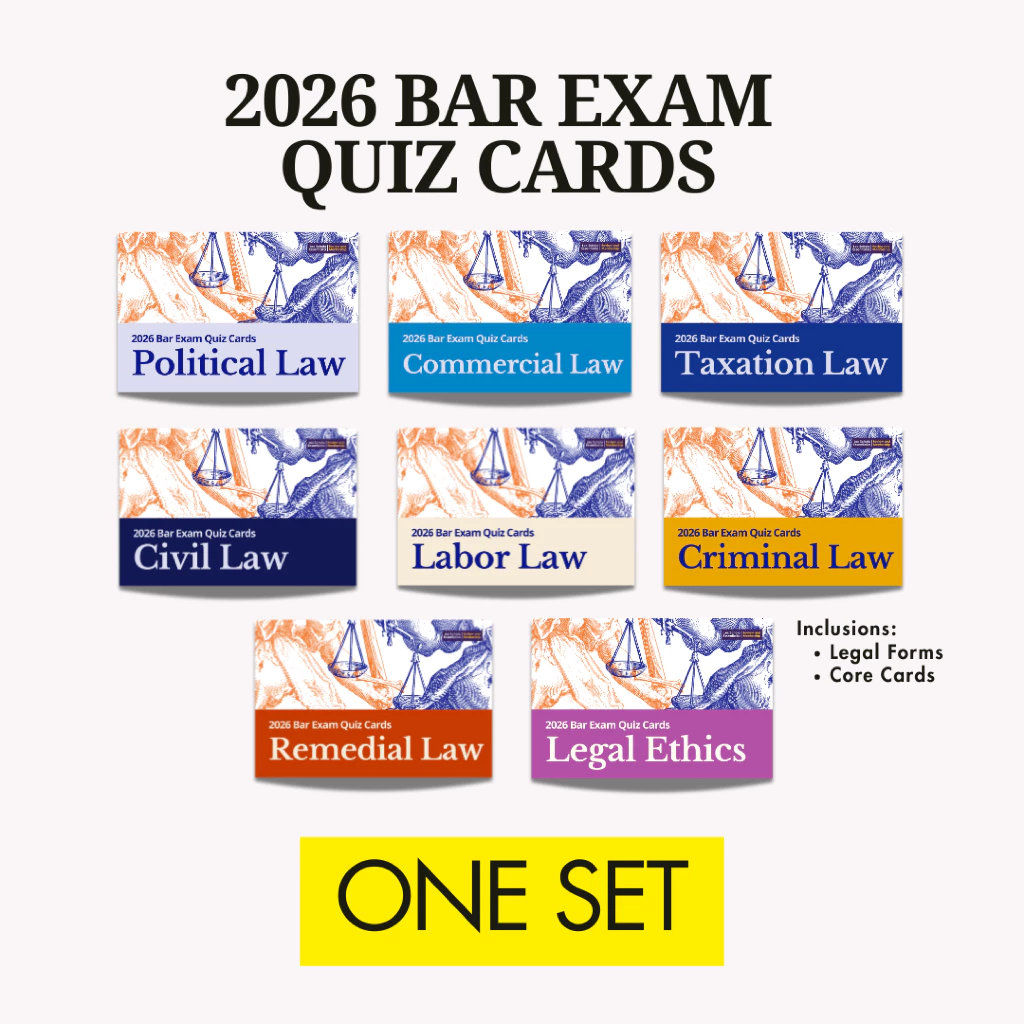
Quiz cards are perfect partners for active recall – short, focused questions that help you test what you know and catch what you still need to work on. Re-reading isn’t enough, what builds mastery is quizzing yourself and checking if you can recall the laws without looking.
These cards include critical Bar Chair cases in Q&A form. Each set comes with legal forms and new core cards, which compile important lists like distinctions and enumerations for quick recall.
Codal Boosters

Codal Boosters are handy supplements in the mastery of the text of the law. Codal provisions that may have been used as legal bases to questions asked in previous Bar are marked, but the actual question and the suggested answer are not indicated – for the premise that each aspiring lawyer have their unique personal style of arguing.
This material provides favorite provisions of the codes or rules; these are very important as these are among the commonly asked during Bar exams. While that is, the reviewer does not forgo a codal provision on the basis that “it is not likely to appear in the Bar” – as nobody can forecast what will actually appear on the exam.
Why Aspire to Become a Filipino Lawyer
A career in law is worthwhile endeavor, something that is not only fulfilling through working for justice but provides prestige and high salary too.
Moreover, lawyers can work in any field. They are highly respected and are often in the frontline in politics, business, education, healthcare, criminal justice, and more. In government, lawyers are much likely a great candidate as legislators, judges, and leaders in the executive branch.
Here are reasons why you should consider enrolling in a law school and get the attorney title:
- Help others through working for justice. Lawyers have undergone tough training in law schools. This have instilled in them, and hurdling law school requires strong sense of justice and a desire to advocate for marginalized communities, uphold rights, and help ensure a fair legal system.
- Prestige and influence. An individual bearing the attorney title receives a distinct level of prestige and status in their communities. Their title carries a certain amount of influence and respect, and they are trusted in legal parameters to enact societal change, especially when serving in governmental roles as policymakers.
- Benefits and salary. Lawyering is one of the careers where you can have independence, meaning you can take charge of your own career and hence can boost their earnings and professional status. In addition, lawyers have the opportunity to earn a lucrative income, averaging from P50,000 to P60,000. But this can skyrocket for about P1.5-million annually or more depending on experience, location, and specialization.
- Mental stimulation. Law practice requires you to think a lot, read a lot, and challenge yourself a lot. Attorneys work through complex legal theories, statutes, and case law to find a solution to a legal question. In addition, they are trained to argue against another attorney on legal theories and points to prove their allegations. Both provides mental stimulation and intellectual challenges – and you really need to do your best and find the most effective strategies to defend your client.

Admission Requirements for the Bar Exams
So, you want to take the Bar Exam? A bar candidate must meet the following academic qualifications:
- Holder of a law degree from a recognized law school in the Philippines and satisfactorily completed the courses on the bar subjects and the mandatory Clinical Legal Education Program (CLEP)
- Holder of a bachelor’s degree with academic credits in certain required subjects from a recognized college or university in the Philippines or abroad
Candidates should also meet certain non-academic requisites:
- A Filipino citizen
- At least twenty-one years of age
- A resident of the Philippines
- Satisfactory evidence of good moral character (usually a certificate from the dean of law school or an immediate superior at work)
- No charges involving moral turpitude have been filed against the candidate or are pending in any court in the Philippines
As of March 2010, the Supreme Court has started allowing Filipino foreign law school graduates to take the Bar Exam provided that they comply with the following:
- Completion of all courses leading to a degree of Bachelor of laws or its equivalent
- Recognition or accreditation of the law school by proper authority
- Completion of all fourth-year subjects in a program of a law school duly accredited by the Philippine government
- Proof of completing a separate bachelor’s degree
Disclosure: This article contains affiliate links and if you purchase through them, I will earn a commission without extra cost on your part.
Success Stories







News to Your Inbox
Fresh insights and exclusive perks delivered straight to your inbox. Sign up now.